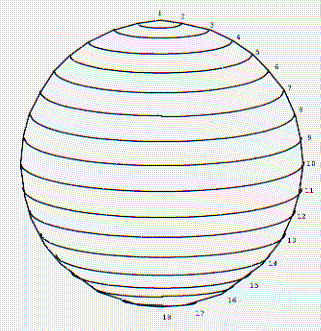
In order to pass the description of the boundary to the subroutines it is represented by the two tables of data 2.E and 2.F. Table 2.E lists the (r,z) coordinates of the vertices and is identified by the real array VERTEX. Table 2.F lists the index of the two vertices that define each panel and is identified by the integer array SELV.
| Table 2.E: Vertices of sphere generator ( VERTEX) | |||||
| Index | r | z | Index | r | z |
| 1 | 0.000 | 1.000 | 11 | 0.985 | -0.174 |
| 2 | 0.174 | 0.985 | 12 | 0.940 | -0.342 |
| 3 | 0.342 | 0.940 | 13 | 0.866 | -0.500 |
| 4 | 0.500 | 0.866 | 14 | 0.766 | -0.643 |
| 5 | 0.643 | 0.766 | 15 | 0.643 | -0.766 |
| 6 | 0.766 | 0.643 | 16 | 0.500 | -0.866 |
| 7 | 0.866 | 0.500 | 17 | 0.342 | -0.940 |
| 8 | 0.940 | 0.342 | 18 | 0.174 | -0.985 |
| 9 | 0.985 | 0.174 | 19 | 0.000 | -1.000 |
| 10 | 1.000 | 0.000 | |||
| Table 2.F: Panels that constitute the sphere ( SELV)) | |||||
| Index | Vertex 1 | Vertex 2 | Index | Vertex 1 | Vertex 2 |
| 1 | 1 | 2 | 10 | 10 | 11 |
| 2 | 2 | 3 | 11 | 11 | 12 |
| 3 | 3 | 4 | 12 | 12 | 13 |
| 4 | 4 | 5 | 13 | 13 | 14 |
| 5 | 5 | 6 | 14 | 14 | 15 |
| 6 | 6 | 7 | 15 | 15 | 16 |
| 7 | 7 | 8 | 16 | 16 | 17 |
| 8 | 8 | 9 | 17 | 17 | 18 |
| 9 | 9 | 10 | 18 | 18 | 19 |