3.7 Special Numerical Integration Methods
Special methods are required to evaluate the singular integrals that
arise in the discrete Lk and Nk operators when the
collocation point lies on the element.
3.7.1 Two-dimensional problems
The regular integrals that arise are approximated by a standard quadrature
rule such as a Gauss-Legendre rule which is specified in the parameter
list to the subroutines. Tables of Gauss-Legendre rules are given in
Stroud and Secrest [79] and can also generated from the
NAG library [63], for example.
The non-regular integrals that arise in the
formulae (3.36) and (3.37) are computed via the following methods. See Jaswon and Symm
[34] and Kirkup [40] for the background to these methods.
The M0 and M0t operators have regular kernels, hence the aim is to
find expressions for the following:
|
{ L0 |
~
e
|
}DG*(p) = |
ó
õ
DG*
|
G0(p,q) dSq , |
| (3.38) |
|
{ N0 |
~
e
|
}DG*(p; np) = |

¶np
|
|
ó
õ
DG*
|
|
¶G0
¶nq
|
(p,q) dSq , |
| (3.39) |
where DG* is a straight line panel,
p Î DG* (though not on an edge or corner of
the panel). Let it be assumed that the panel DG*
has length a+b with q = q(x) and p = q(3.32)
for x Î [-a,b]. This gives the following formulae for (3.38)
and (3.40):
|
{ L0 |
~
e
|
}DG*(p) = |
1
2 p
|
[ a + b - a loga -b logb ] , |
| (3.40) |
|
{ N0 |
~
e
|
}DG*(p; np) = - |
1
2 p
|
[ |
1
a
|
+ |
1
b
|
] . |
| (3.41) |
3.7.2 Three-dimensional problems
The regular integrals that arise are approximated by a quadrature rule
defined on a triangle. Laursen and Gellert [56] contains a selection
of Gauss-Legendre quadrature rules for the
standard triangle. The non-regular
integrals that from discretising the Lk and Nk operators
are computed by the following
methods. See Jaswon and Symm [34], Terai
[80], Banerjee and
Butterfield [7] and Kirkup [40] for
the background to these methods.
The M0 and M0t operators have regular kernels, hence the aim is to
find expressions for:
|
{ L0 |
~
e
|
}DG*(p) = |
ó
õ
DG*
|
G0(p,q) dSq , |
| (3.42) |
|
{ N0 |
~
e
|
}DG*(p; np) = |

¶np
|
|
ó
õ
DG*
|
|
¶G0
¶nq
|
(p,q) dSq , |
| (3.43) |
where DG* is a planar triangular panel,
p Î DG* (though not on an edge or corner of the
panel). Let R(q) be the distance from p to the edge of
the panel for q Î [0, 2 p], as illustrated in Figure 3.1.
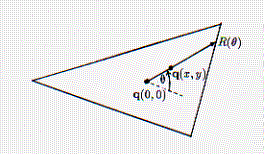
Fig 3.1. Polar integration on the planar triangle panel.
The integrals (3.42) and (3.43) may be written in the form:
|
{ L0 |
~
e
|
}DG* (p) = |
1
4 p
|
|
ó
õ
|
2 p
0
|
R(q) d q , |
|
|
{ N0 |
~
e
|
}DG* (p; up) = - |
1
4 p
|
|
ó
õ
|
2 p
0
|
|
1
R(q)
|
d q . |
|
In order to evaluate the integrals, the triangular panel
DG* is
divided into three \triangle1, \triangle2 and \triangle3
by joining the point p to the vertices.
The resulting triangles have the form of Figure 3.2.
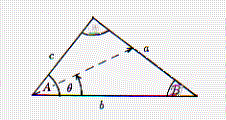
Fig 3.2. Division of the planar triangle panel.
After some elementary analysis, we obtain
|
{L0 |
~
e
|
}DS* (p) = |
å
\triangle1, \triangle2, \triangle3
|
|
1
4 p
|
R(0) sinB( logtan( |
B+A
2
|
) - logtan |
B
2
|
) and |
|
|
{N0 |
~
e
|
}DS* (p; up) = |
å
\triangle1, \triangle2, \triangle3
|
|
1
4 p
|
|
cos(B+A) - cosB
R(0) sinB
|
. |
|
3.7.3 Axisymmetric three-dimensional problems
The regular integrals that arise are approximated by a two-dimensional
quadrature rule defined on a rectangle which is specified in the
parameter list to the subroutine. These integrals
can be approximated using a Gauss-Legendre rule in the generator and
q directions.
The non-regular integrals that arise in the
formula are computed by the following methods.
The M0 and M0t operators have regular kernels, hence the aim is to find
expressions for the following:
|
{ L0 |
~
e
|
}DG*(p) = |
ó
õ
DGol>G*
|
G0(p,q) dSq , |
| (3.44) |
|
{ N0 |
~
e
|
}DG*(p; np) = |

¶np
|
|
ó
õ
DG*
|
|
¶G0
¶nq
|
(p,q) dSq , |
| (3.45) |
where DG* is a conical shell panel,
p Î DG* (though not on an edge of the panel).
The integral in (3.44) is evaluated through dividing the integral with
respect to the generator direction into two parts at p and
transforming the integral through changing the power of the variable
in line with a method described in references [25]
and [40].
The resulting regular integral on both parts is computed via the
quadrature rule supplied to the routine.
The integral in (3.45) is evaluated by using the result that if the
surface of integration in (3.45) is extended to
enclose a three-dimensional volume then the integral vanishes
(see [40]). As each panel is a truncated
right circular cone shell
a 45° right circular cone is added to each flat side of the
panel. The integrals over the two 45° cones are regular
and are computed by a composite rule based on the quadrature
rule based on the quadrature rule supplied to the subroutine.
The solution is thus equal to minus the sum of the integrals over the
two 45° cones.
Return to boundary-element-method.com/acoustics
Return to boundary-element-method.com