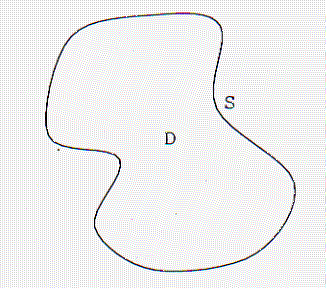
Fig 4.1. The domain of the interior acoustic problem.
Fig 4.1. The domain of the interior acoustic problem.
Following the analysis of Subsection 1.3.1, the problem is equivalent to the solution of the Helmholtz equation
|
| (4.1) |
In this application the finite element method is now an established computational technique (ref. [68], [69]) and it may well also be often more efficient than the BEM . However, the BEM allows much more flexibility when the geometry of the domain is complicated and is a more natural method to apply if the domain is to be coupled with neighbouring domains in a wider computational method.
The volume of published research into the problem of determining the acoustic field within an enclosure or cavity by the boundary element method is minute in comparison to that of the corresponding exterior problem. There are two important reasons for this. The first is that the interior problem can be solved much more straightforwardly by the finite element method than the exterior problem, hence there is no pressing need for an alternative method. The other reason is that the development of the BEM for the exterior problem has been beset by difficulties; extensive research has been required to achieve reliable methods. The BEM for the interior problem is relatively straightforward.
The boundary element method for the solution of the interior acoustic boundary-value problem have been developed in Bell et al (1977) Bernard et al (1987), and Kipp and Bernard (1987). Further analysis or applications of the method are described in Seybert and Cheng (1978) Cheng et al (1991) and Kopuz and Lalor (1995) In this Chapter the application of the BEM to the interior acoustic problem is developed further so that the solution with a general boundary, boundary condition and incident field can be obtained. The subroutines AIBEM2, AIBEM3 and AIBEMA [33] for solving the two-, three- and axisymmetric three-dimensional problems are described and demonstrated.