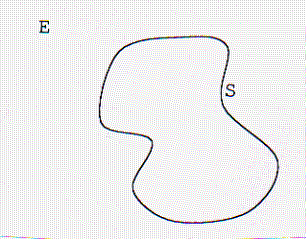
Fig 5.1. The domain of the exterior acoustic problem
Fig 5.1. The domain of the exterior acoustic problem
The problem is equivalent to the solution of the Helmholtz equation
|
| (5.1) |
Although the exterior Helmholtz equation can be solved by the finite element or finite difference methods ( see, for example, Harari and Hughes [30]), such methods are clearly awkward to apply and probably inefficient since the domain is infinite. The boundary element method has an important strategic advantage over the alternative methods in that it requires discretisation of the boundary only. The solution at points in the domain can then be obtained by a straightforward integration of the boundary functions.
The application of the BEM to acoustic radiation and
scattering problems has been investigated by researchers over
the past three decades or so. Early contributors (see references
[18], [21]) applied what may be called
elementary methods; methods derived in the standard way from the
integral equations arising from Green's second theorem (generally
known an the Helmholtz formula of the Helmholtz-Kirchoff equation)
or a single- or double-layer representation. However, the resulting
BEMs, the elementary methods,
were subsequently found to give unreliable results for all
but a relatively low range of wavenumber. They are generally
reliable for wavenumbers such that kD < 4.0,
where D represents the diameter of the body or the maximum
distance between any two points on the
boundary - much too restrictive a condition for most applications.
There has been a large number of contributors
to the research and development
of boundary element methods for the solution of the exterior
acoustic problem.
Alternative integral formulations
of the exterior Helmholtz equation were introduced in
references [12], [57], [66],
[54] and [15] and these will
be termed the improved formulations.
A further non-standard BEM , based on the original
integral equation formulations but being demonstrably
more reliable, was introduced by
Schenck [75] and this has since become very popular
since it turns out to be rather easier to implement than
the methods based on the alternative formulations.
Early reviews of these and other methods are given in Burton
[16], [17] and Kleinmann and Roach
[51]. The monograph
by Amini et al [3] contains a more recent review.
The main difficulty with the improved formulations is that they generally involve the Nk integral operator. Although methods can be developed for its discretisation, they are notoriously difficult to devise and program. Nevertheless, as far as this work is concerned, the discretisation of all the operators has been programmed for the simple elements covered in Chapter 2. Hence the presence of the Nk operator is no barrier to the implementation of these methods for the purposes of this work. In this Chapter the most important integral equation formulations and methods are considered. The subroutines AEBEM2, AEBEM3 and AEBEMA [33] for solving the two-, three- and axisymmetric three-dimensional problems are introduced.