7 Test Problem: Sound Pressure Field of Circular and Square Pistons
The test problem is that of a uniformly vibrating circular piston of radius 0.1,
centred at (0,0,0)
at wavenumbers k=10 and k=25. If v(p) = -V (p Î P) is the velocity of the
piston (uniform over its surface) then the sound pressure P(p)
at a point p=(0, 0, p3) on the axis of the piston is given by
P(p) = rc V ( ei k (0.01 + p32 )[1/2] - ei k p3 )
see, for example, Skudrzyk [13], pp631-633.
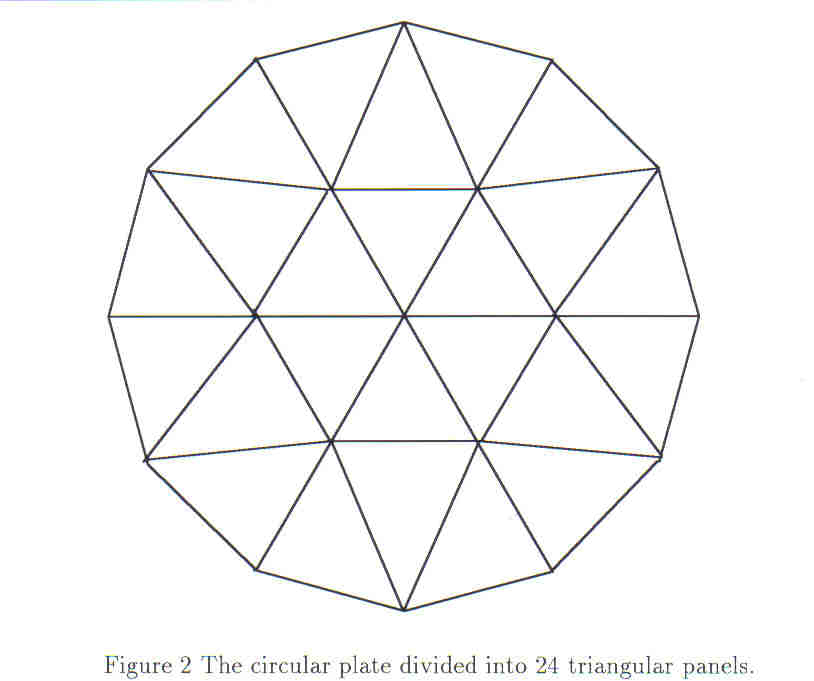
The circular piston is divided into 24 triangles, as shown in figure 2.
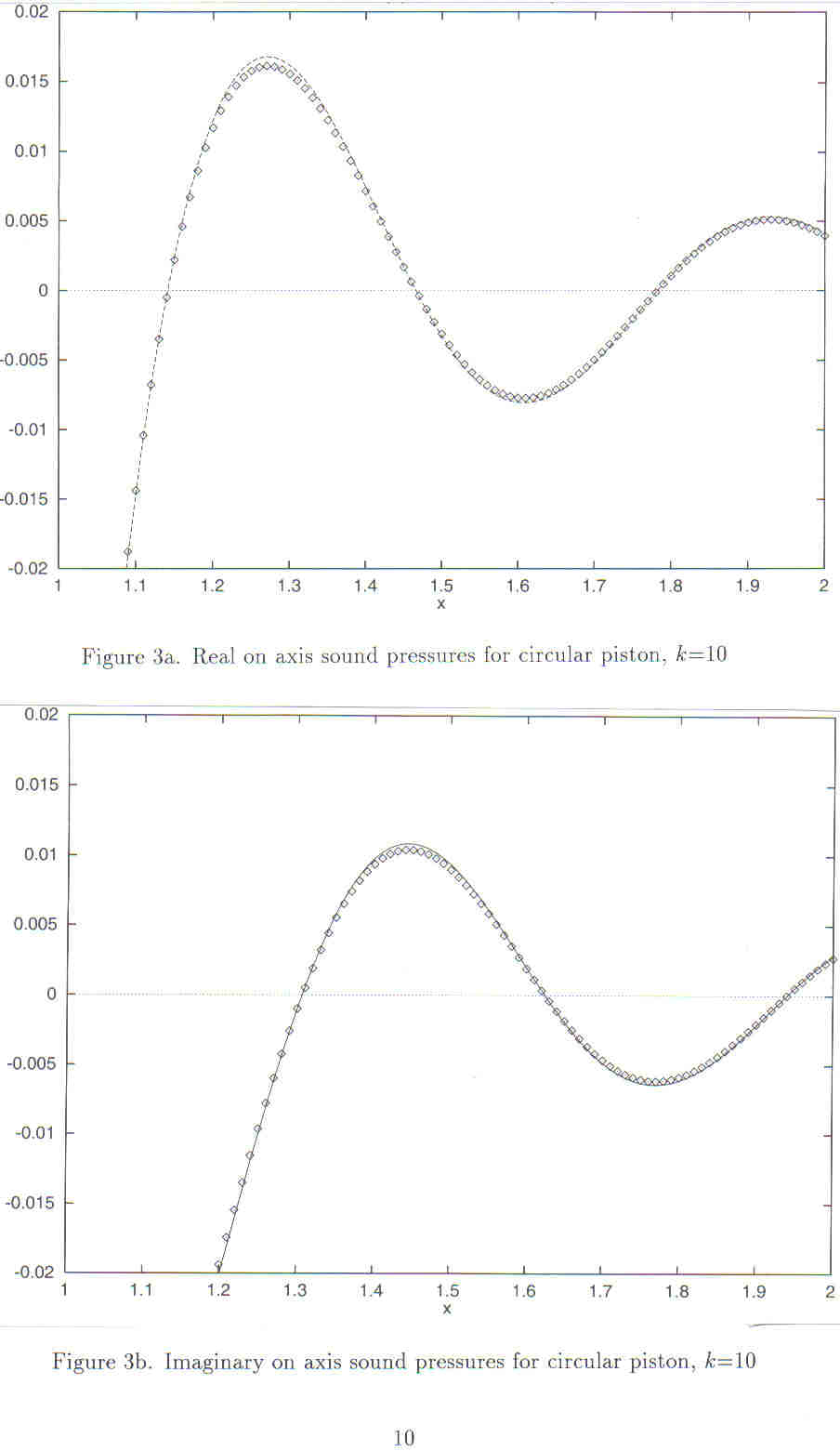
Figures 3 compare the computed and exact on axis sound pressure obtained
from the
subroutine at twenty points with exact values for k=10.
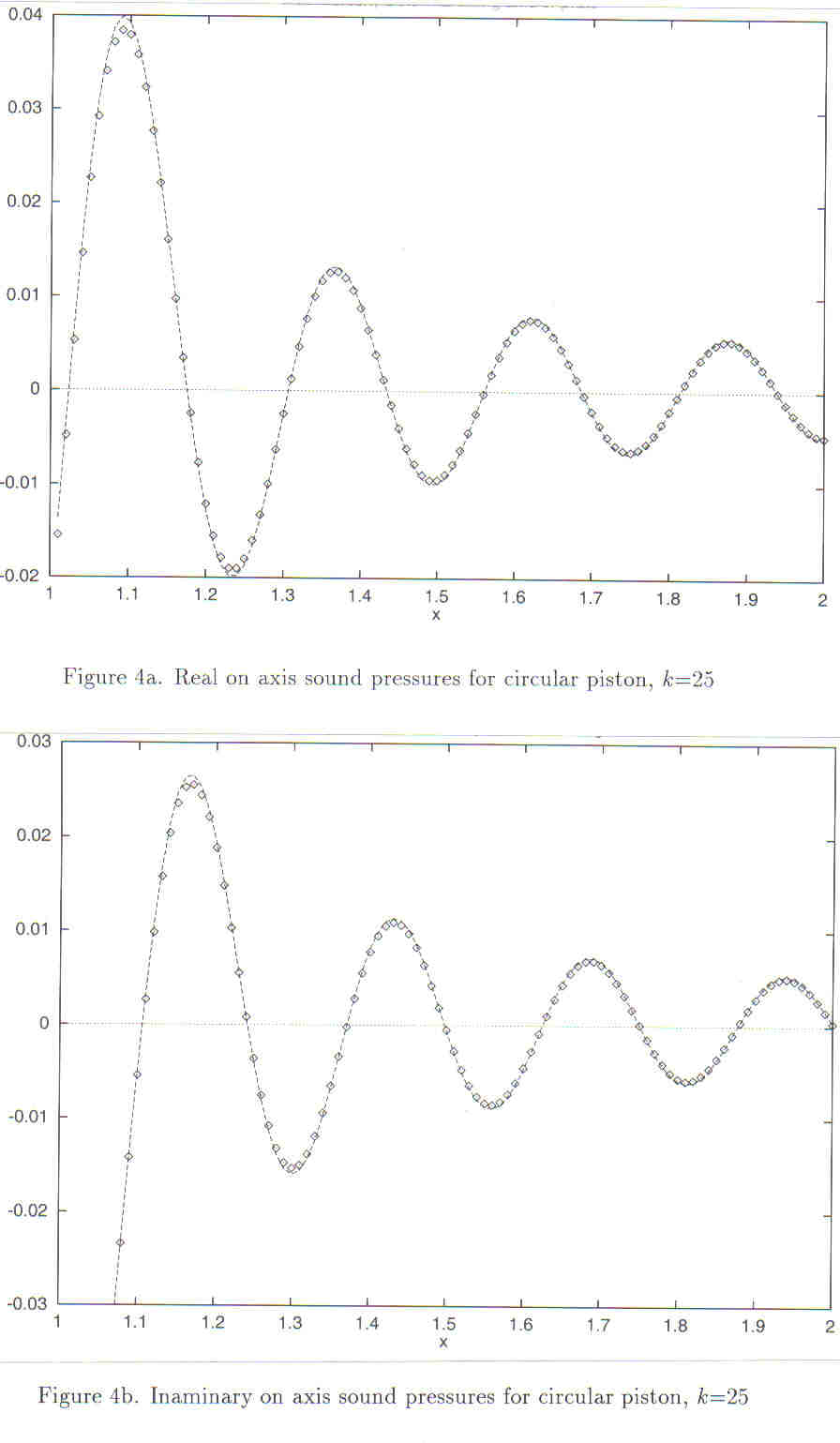
Figures 4 compare the same but with k=25.
The second test problem is that of a uniform square plate
with its sides
hinged onto an infinite rigid baffle. The [0,1] ×[0,1] square is
vibrating in its natural modes which are
v(p) = sin(l pp1) sin( m pp2) (p Î P)
(18)
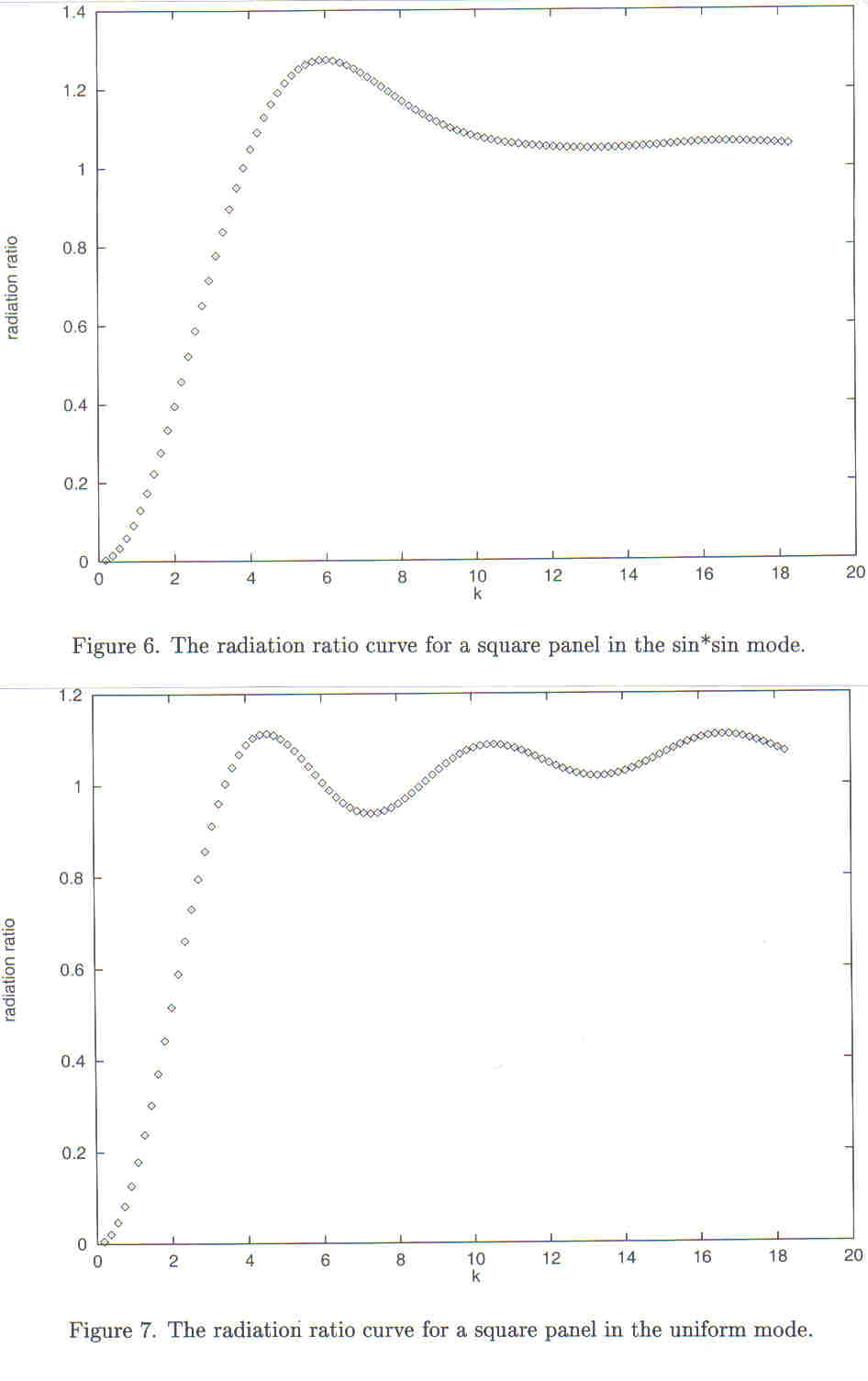
where l and m are integers. The property that is of interest is the
radiation ratio of the plate vibrating in each of its mode shapes (18).
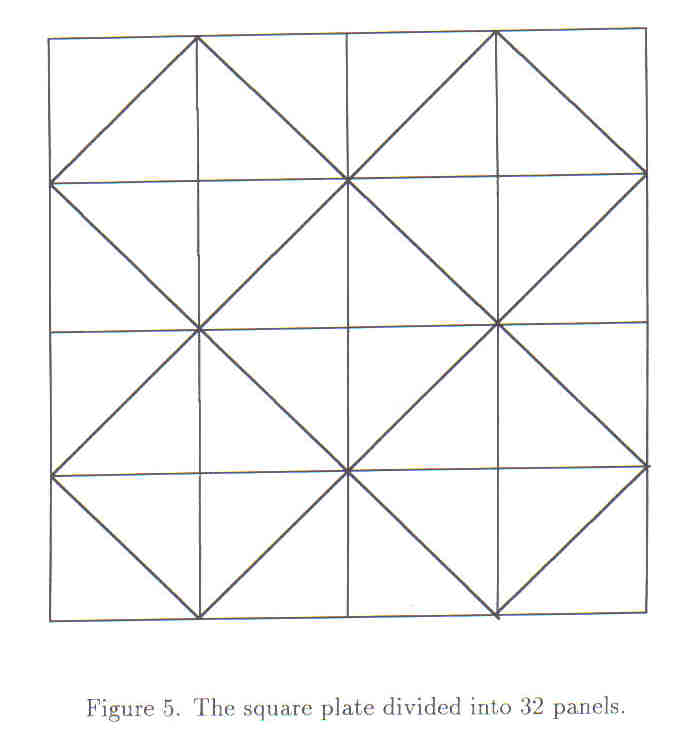
In order to apply the subroutine to the problem, the square plate is
divided into
32 triangles, as shown in figure 5. The mode shapes considered were
the sixteen
given by putting l=1 and m=1 in (18). The wavenumbers
at which the radiation ratio is computed are
k = 0.0, 0.2, 0.4, ..., 34.8, 20.0 .
Figures 6 show the radiation ratio curves constructed from the
results of the
subroutine run.
The final test problem is that of the same square plate as in the
previous example, having the same discretisation but with it
vibrating uniformly. The radiation ratio curve for this is shown
in figure 7.